
Introduction
Securing accommodation is one of the biggest challenges any student faces before arriving in the UK — and for international students booking from abroad, scammers know exactly how to exploit it. The National Fraud Intelligence Bureau (NFIB) reports that young people aged 18 to 39 account for nearly three-quarters of all rental fraud cases, with close to £9 million lost across approximately 5,000 reported incidents each year. The August–September intake window is peak season, as demand surges and students face intense pressure to secure rooms before they arrive. This guide covers every major scam type, how to spot them, and exactly what to do to stay safe.
What Are the Most Common Student Accommodation Scams in the UK?
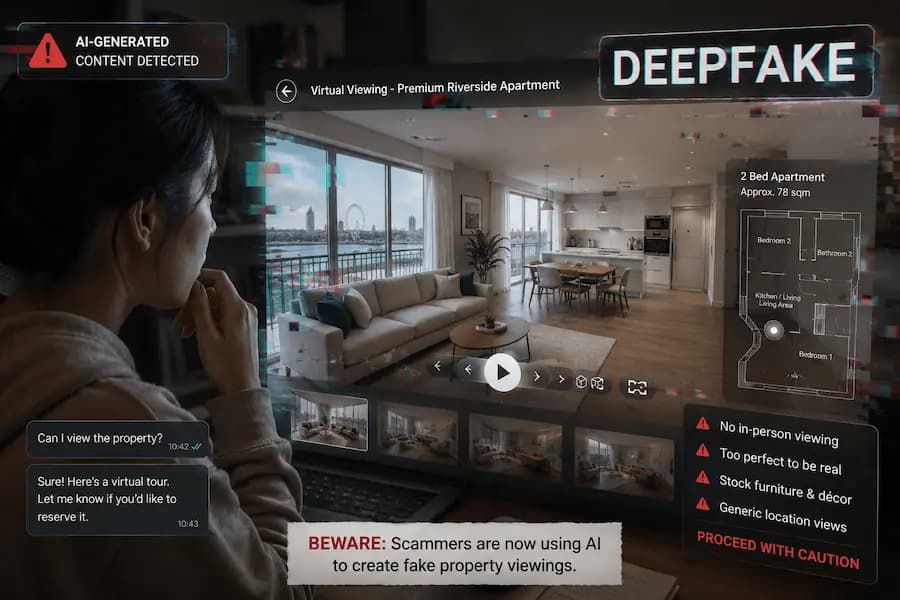
Fake property listings, advance payment fraud, deposit scams, social media scams, and AI-generated fake viewings are the most common student accommodation scams in the UK. Most target international students booking remotely, under time pressure, and unfamiliar with UK tenancy law.
Here are the scam types every student needs to know:
Fake Listings: Scammers copy real property photos and advertise fake, cheap rentals.
Hijacked Adverts: Real listings are reposted with the scammer’s contact details.
Advance Payment Scams: Fake landlords ask for deposits and rent upfront, then disappear.
Deposit Fraud: Deposits may not be legally protected in an approved scheme.
Social Media Scams: Fraudulent listings are common in Facebook and WhatsApp student groups.
AI Fake Viewings: Scammers can now create realistic AI-generated property videos, so video viewings alone aren't enough.
Tip: Always verify the landlord/property independently and never rush into sending money.
What Are the Warning Signs of a Student Accommodation Scam?
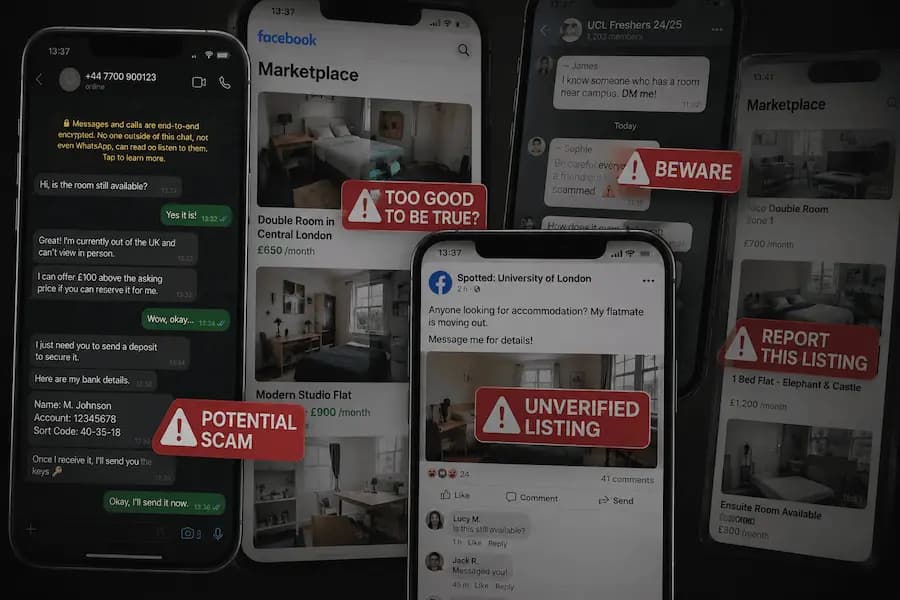
The key red flags are rental prices significantly below the local market rate, requests for payment before viewing, a landlord claiming to be overseas, communication only via WhatsApp or Gmail, and no tenancy agreement before payment is requested.
Check every listing against this list before paying anything:
Rent is noticeably cheaper than similar properties on Rightmove or Zoopla (a central London studio under £850/month, for example, is almost never genuine)
Landlord says they are "currently abroad" and cannot do a live real-time video call
You are asked to pay a deposit or holding fee before signing any agreement
Communication happens only through WhatsApp, Telegram, or a personal Gmail address
You are told other students are interested and must decide within 24–48 hours
Listing photos appear elsewhere online under a different address or agent name (reverse image search to check)
The letting agent cannot be found on the Property Ombudsman website (tpos.co.uk)
No formal tenancy agreement is provided before payment is requested
Payment is requested by cash, cryptocurrency, gift card, or wire transfer
If two or more of these apply to the same listing, stop all contact and do not pay.
Student Accommodation Scams
UK Student Accommodation Scams
Fake Property Listings
Stolen photos are used to advertise properties that don’t belong to the scammer.
Avoid: Reverse image-search photos and never pay before a live viewing.
Hijacked Adverts
Real listings are copied with the scammer’s contact details.
Avoid: Verify the address on Rightmove/Zoopla and use the original contact details.
Ghost Landlord
A fake landlord claims to be abroad and asks for payment before viewing.
Avoid: Never pay before properly verifying the landlord and property.
Deposit Fraud
Deposit is taken but not properly protected.
Avoid: Ask which approved deposit scheme is being used and get confirmation.
Social Media Scams
Fake listings appear in Facebook groups and WhatsApp chats.
Avoid: Use trusted accommodation platforms and independently verify contacts.
AI Fake Viewings
AI-generated videos are used to fake property tours.
Avoid: Verify the property using Land Registry records and Google Street View.
Phishing Emails
Fake emails imitate Rightmove or university portals to steal information.
Avoid: Don’t click suspicious links; check the sender and website carefully.
Contract Scams
Fake or illegal tenancy agreements are used to collect money.
Avoid: Get the contract checked by your university or Citizens Advice before signing.
How to Verify a Landlord Before You Pay
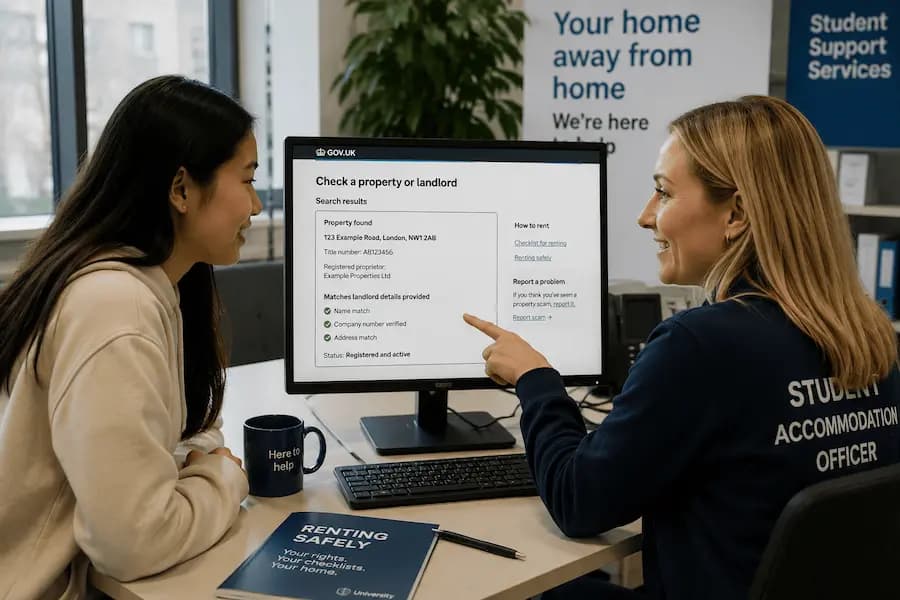
Verify a landlord by reverse image searching the listing photos, checking the property title on HM Land Registry, confirming the letting agent on the Property Ombudsman register, and completing a live video viewing where the landlord shows the building exterior in real time.
Follow these five steps before transferring any money:
1. Reverse Image Search the Photos — Right-click any listing photo and search it on images.google.com or tineye.com. If the same image appears under a different property name, address, or platform, the listing is fraudulent.
2. Search HM Land Registry — Visit landregistry.gov.uk (around £3) and confirm the registered owner's name matches the person renting to you. Different names require a written explanation before you proceed.
3. Verify the Letting Agent — All letting agents in England must be registered with a Property Redress Scheme. Check them at
tpos.co.uk (Property Ombudsman) or arla.co.uk (ARLA Propertymark). Search the company at companieshouse.gov.uk to confirm it exists and is active.
4. Complete a Live Verified Video Call — Request a real-time video call where the landlord shows the building's front door from the street, walks to a window, and describes what they can see outside. These requests cannot be faked with pre-recorded or AI-generated content.
5. Ask Your University Accommodation Office — Most universities maintain approved landlord registers and can verify whether a listing is legitimate. In Scotland, check landlordregistrationscotland.gov.uk.
What to Do If You Have Been Scammed
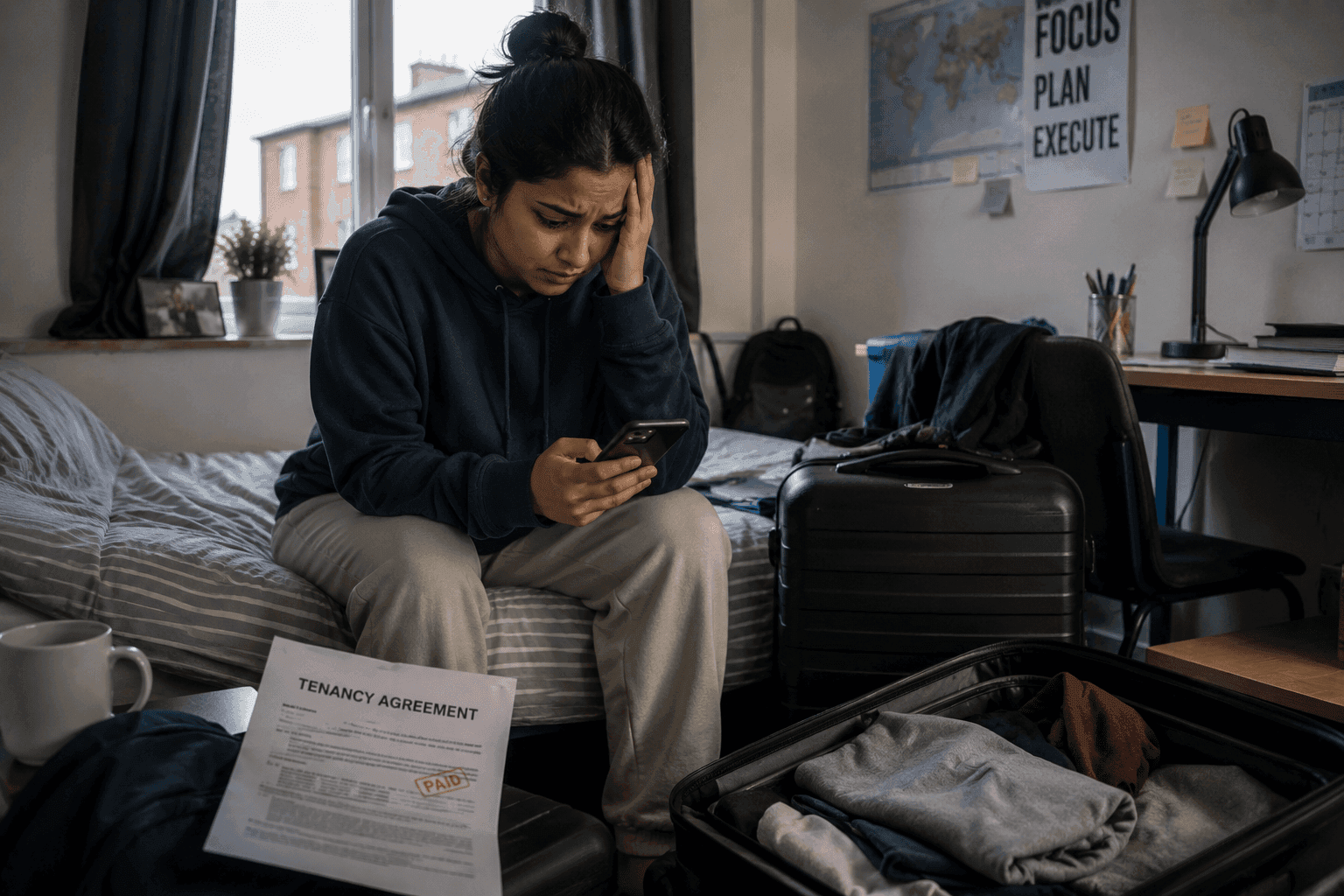
Stop all payments, contact your bank within 24 hours to request a payment recall, and report to Action Fraud
(actionfraud.police.uk / 0300 123 2040). Credit card payments between £100–£30,000 are covered by Section 75 of the Consumer Credit Act 1974 — your provider may be jointly liable.
Act in this order:
Call your bank now — UK banks must consider reimbursing victims of Authorised Push Payment fraud. Speed is critical.
Use Section 75 if you paid by credit card — For payments between £100 and £30,000, your credit card provider is jointly liable under the Consumer Credit Act 1974.
Report to Action Fraud — actionfraud.police.uk or 0300 123 2040. They issue a crime reference number your bank will need. In Scotland, report to Police Scotland on 101.
Preserve all evidence — Save every message, listing screenshot, receipt, and document before anything is deleted.
Contact your university — International student support teams can advise on emergency housing and provide wellbeing support.
Quick Tips to Avoid Student Accommodation Scams
Reverse image search every listing photo — this single step catches the majority of fake listings.
Never pay before a live verified viewing — a real-time call where you control what the camera shows.
Check the landlord on HM Land Registry — £3 confirms who legally owns the property.
Verify letting agents on tpos.co.uk and companieshouse.gov.uk — unregistered agents should not receive your money.
Use a credit card where possible — Section 75 of the Consumer Credit Act provides joint liability protection up to £30,000.
Ask which Deposit Protection Scheme they use — any legitimate landlord in England or Wales answers this immediately.
Start your search 4–6 months early — time removes the pressure scammers rely on.
Contact your university if in doubt — use your accommodation office before you pay, not only after a problem arises.
Conclusion
Student accommodation scams can cause serious financial and personal problems, especially for international students. By verifying the property and landlord, avoiding upfront payments, checking official records, and seeking help from the university, students can significantly reduce the risk of being scammed. Always verify before you pay.